
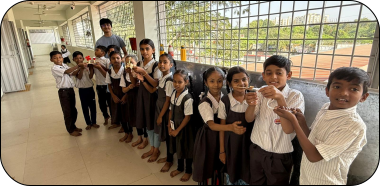

Getting fifty STEM kits into a school in Gujarat took a lot longer than the single afternoon we actually spent there. The real work started months earlier, in a stretch of emails and phone calls to schools and organizations across the region, sorting out which communities had students who could genuinely use this kind of hands-on learning and which had the space and staff to host us. Logistics ate up their own share of time too, since fifty kits, half built around hydraulics and half around basic circuitry, had to be designed, assembled, and shipped before we ever set foot in a classroom. All of that groundwork led to a single afternoon: an in-person visit where we finally watched the kits get used by the kids they were built for.
We build kits like this because they're one of the more direct ways to put real STEM material in front of students who don't usually have access to it. The hydraulics kits rely on two syringes, some tubing, and water to demonstrate how pushing fluid through a closed system can move something else entirely, the same principle behind an excavator bucket or a dentist's chair. The circuitry kits work with basic components, wires, a battery, a switch, so students can wire together a working circuit and watch it actually turn something on. Both halves are aimed at the same outcome: giving a kid something to build with their hands instead of something to be told about from the front of a room.
Aum, who's on our team, spent the day of the visit on the floor with the students, moving from table to table as the kits came together piece by piece. Fifty kits worked out to roughly two hundred students split into small groups, most of them assembling at more or less the same time, comparing notes across tables as they went.
One kit in particular stuck with people afterward: the windmill build from the hydraulics half, which turned when the syringes were worked in the right sequence and kept turning long after anyone stopped pushing. "The STEM kits made my week and was a fun way to learn about the windmill," a student named Anaya told us, and that response is really the whole reason this work matters to us. A kid who has only read about hydraulics in a textbook occupies a different world entirely from a kid who has felt the resistance inside a syringe and worked out, hands first, why pushing here makes something move over there.
A government school in Gujarat is full of curious kids. Curiosity turns into real understanding only when there are actual materials to build with, and those are exactly the kind of hands-on supplies that get cut first whenever a school budget tightens. Fifty kits are a real start toward closing that gap, small compared to the scale of the problem but concrete enough to point to and build from.
The in-person visit was really the culmination of a process that had been building for a while before that day. Gujarat is also where we've been running a longer-term makerspace, stocked with 3D printers and laptops, for the same students who want to keep going after a single afternoon of building. The kits tend to be the first thing kids do with us, and the makerspace is what's waiting there for the ones who want to keep doing it.