

Four working makerspaces in Jamaica are the visible result of a process that started with something far less photogenic: months of conversations with legislators, with charitable organizations already embedded in these communities, and with anyone who held a genuine relationship with the towns we hoped to reach. Establishing those relationships took the kind of patience that never shows up in a finished space full of printers, and going in without it would have meant arriving with a solution nobody had actually asked for.
Once those relationships existed, fundraising became the next real obstacle. Printers, laptops, and physical space all carry a cost that doesn't disappear after an opening ceremony, and we were determined to fund something durable enough to survive years of operation rather than just the optics of a launch day.
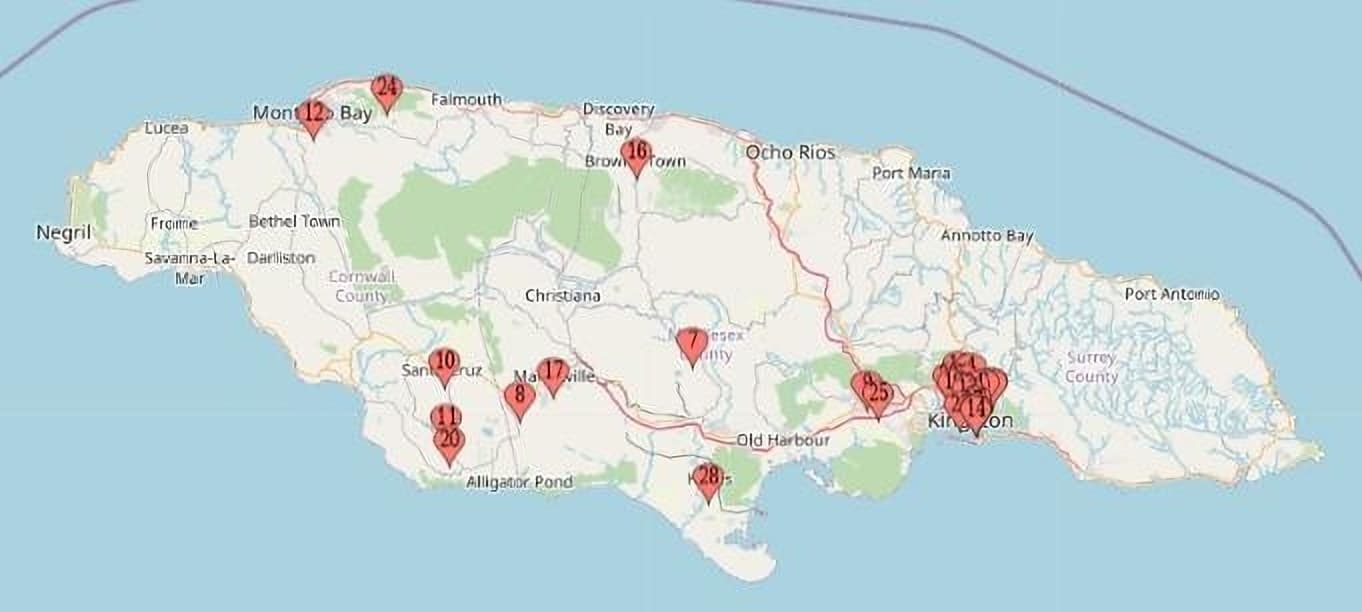
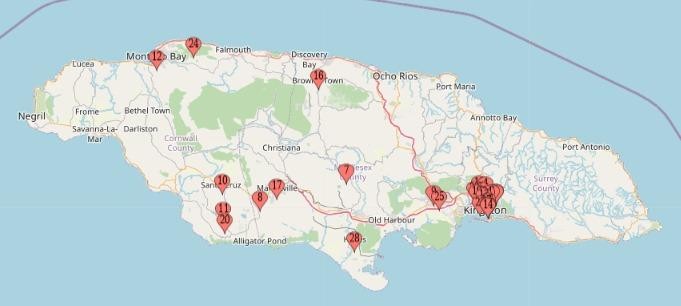 Mapping candidate locations across Jamaica, parish by parish
With funding secured, we turned to mapping the island itself, parish by parish, weighing candidate locations against population density, existing school infrastructure, and the realistic distance a student could travel to reach one. That process eventually narrowed dozens of possibilities down to four, and once those four were chosen, we financed and purchased the spaces outright, then split nine 3D printers across them.
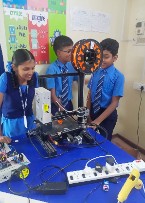 Students at one of our four Jamaican makerspaces
Hardware sitting unused solves nothing, so we built our own scheduling software, custom enough to handle shared community equipment rather than the office-hours logic most off-the-shelf tools assume. Students and community members could reserve time on a specific printer instead of wandering in and hoping one happened to be free. Alongside that, we ran a series of online bootcamps that introduced the basics of CAD design and 3D printing before students ever set foot inside one of the four physical spaces, so their first real day there was spent building instead of orienting.
None of this stays running on its own momentum. We continue talking with the same legislators and organizations who helped us open these spaces in the first place, since printers eventually need replacement parts, software needs updates, and a makerspace three thousand miles from most of our team survives only if the local relationships around it stay as strong as the equipment inside it.
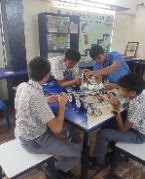 Students building at one of our Jamaican makerspaces
A surprising amount of the real work happened before any of the four locations were chosen at all, in an early map of the island covered with dozens of candidate pins, each one weighed against the others for months. That map, unglamorous as it is, is the reason the four locations we ended up with actually made sense: real population numbers, real school infrastructure, real travel distances, all weighed against each other long before anyone approved a single site.