


Ask a room full of elementary schoolers what an engineer does, and you'll get a hundred different answers, most of them involving explosions. Most younger students believe that being an engineer or a doctor, or really pursuing any career in STEM, is something that only "smart" people are qualified for. They count themselves out because they aren't a genius at math or great at science. However, the only thing a person actually needs to be successful in STEM is curiosity, which is something every young kid has in abundance. After that, all it takes to foster interest is a moment to spark curiosity and an opportunity to enter into the world of STEM is. At STEM For Tomorrow, we strive to provide both of those to students across the globe, and what better place to start than our own community? That's why our goal for this initiative was to introduce young students to STEM and prove that it isn't as difficult as it seems by bringing robotics directly to the students, parents, and teachers in our local community.
How It All Started
Our team from STEM For Tomorrow signed up to run booths at STEM nights across elementary and middle schools in the Lewisville Independent School District. Our main goals were demonstrating how our local robotics program functions and allowing people to experience the world of robots for themselves rather than simply telling them about it.
That's why we took the time to build our very own FIRST Tech Challenge robot to give the members of our community the best, hands-on experience possible.. We packed up a FIRST Tech Challenge robot and set up a booth at schools like Flower Mound Elementary, Old Settlers Elementary, Bridlewood Elementary, McKamy Middle School, and Forestwood Middle School. We reached 11 schools in total by the time the season wrapped up.
Our booth had two parts. The first was the main attraction, and the reason why our booth garnered so much attention: a driver station where any student could grab the controller and drive our robot on a 6ft by 6ft tile surface. The second was less flashy but just as important: a slideshow we built for the parents and teachers, walking them through how FIRST Robotics actually works and, more importantly, how they could sign their own kids up if they were interested. We figured out pretty quickly that the two audiences needed completely different things. The kids just needed thirty seconds and a controller. The parents and teachers needed a lot more attention. We gave them all the information they could possibly need when it comes to robotics, like what FIRST is, what a season looks like, what costs and fees they could expect, and what exactly their child would take part in on a day-to-day basis. We found that most families were genuinely interested in joining robotics, but they simply lacked a way into the door.
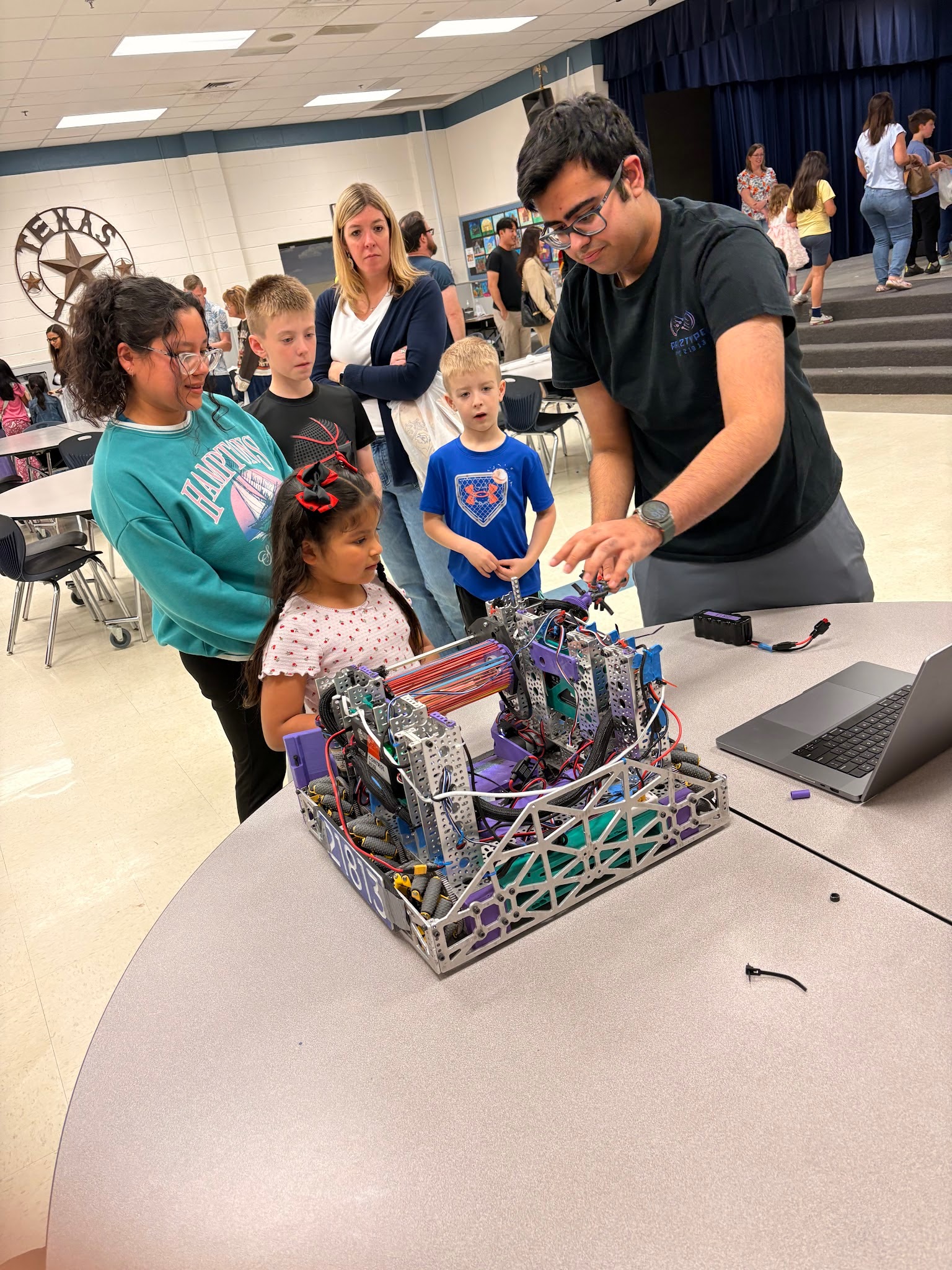 Demonstrating our robot at one of our STEM Nights booths
Watching It Click
Although there were so many people we introduced to the world of robotics, the most important thing for us wasn't the number of people who took a sign-up sheet home or scanned the QR-code to join. While those are still important, what mattered most to us was how excited every kid became when they realized they could control a whole robot all by themselves.
We saw it over and over. Most of the students tentatively picked up the controller, thinking the slightest mistake might cause the robot to fall apart entirely. Then we would show them the basic controls, let them observe how fast the robot moved, give them the controller and step back. We saw that after just a few seconds of driving, most kids were able to get the hang of the robot's movements. After that, the nervous expression on their faces almost instantly transformed into pure happiness. Since these were elementary schoolers, once they gained their confidence back, they started trying all sorts of silly maneuvers and movements. One kid at Old Settlers Elementary drove the robot around in circles for a minute straight, laughing the entire time. Another kid seriously asked if she could take the robot home.
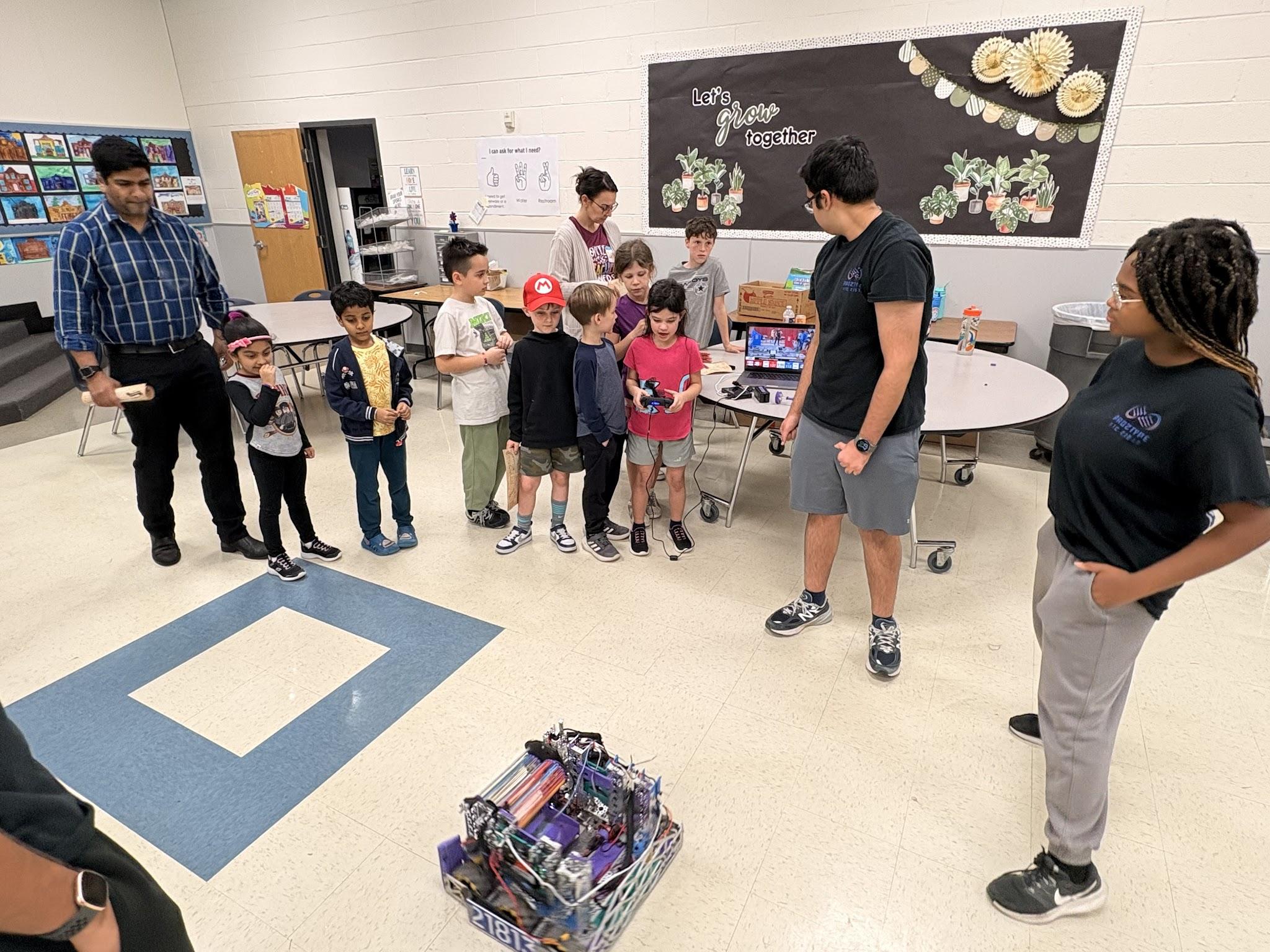 A student taking a turn at the driver station
That's the reason why most of us team members at STEM For Tomorrow fell in love with robotics in the first place. When you're the one making a robot move, it almost feels like it's a part of you.
More Than a Demo
For us, the purpose of our STEM Nights wasn't to show off a robot. The robot was just what lured people in. What we really cared about were the parents who left knowing their kid had an option they hadn't known about, the teachers who pulled us aside to ask how to start a team at their own school, and the students who maybe went to bed that night thinking that becoming an engineer and creating something awesome was something they could do.
By the end of the season, we'd connected with over 1,000 students, parents, and teachers across those eleven schools. While we are proud of that big number, behind it were a thousand smaller moments, like individual conversations, first drives, and wide-eyed questions that we value a lot more. That's the real impact that all of us at STEM For Tomorrow will remember and strive for more of going forward.
Conclusion
We started STEM For Tomorrow because we believe that curiosity and talent are everywhere, but opportunity isn't. STEM nights were our way of closing that gap in the place we know best: our own community.
We can't measure the full impact of a single night. We don't know which of those kids will remember the evening they drove a robot around their school gym, or which parent will end up signing their child up for a team next fall. But we believe that at least one kid we talked to is a future engineer who just got their start at one of our booths, controller in hand, grinning because they just made a robot move for the very first time.