

Horizon Hacks successfully hosted its second hackathon, bringing together over 200 participants from around the world to tackle one powerful question:
How can artificial intelligence be used to create a more accessible and equitable future?
This year’s theme, AI for Accessibility and Equity, challenged participants to look beyond flashy demos and instead focus on real-world impact. The goal was simple: empower students to design AI-powered tools that help close gaps in education, healthcare, financial literacy, and access to essential services for underserved communities.
Turning Purpose Into Innovation 💡
Across the week, participants worked on projects that addressed barriers millions of people face every day. From limited access to quality education and healthcare to language barriers and learning differences, teams were encouraged to think critically about who technology leaves behind and how AI can help bridge that gap when used responsibly.
Projects spanned multiple tracks including health and wellness, education technology, finance, and assistive technology. Submissions ranged from AI tutors and accessibility tools to platforms supporting cognitive development and learning diversity.
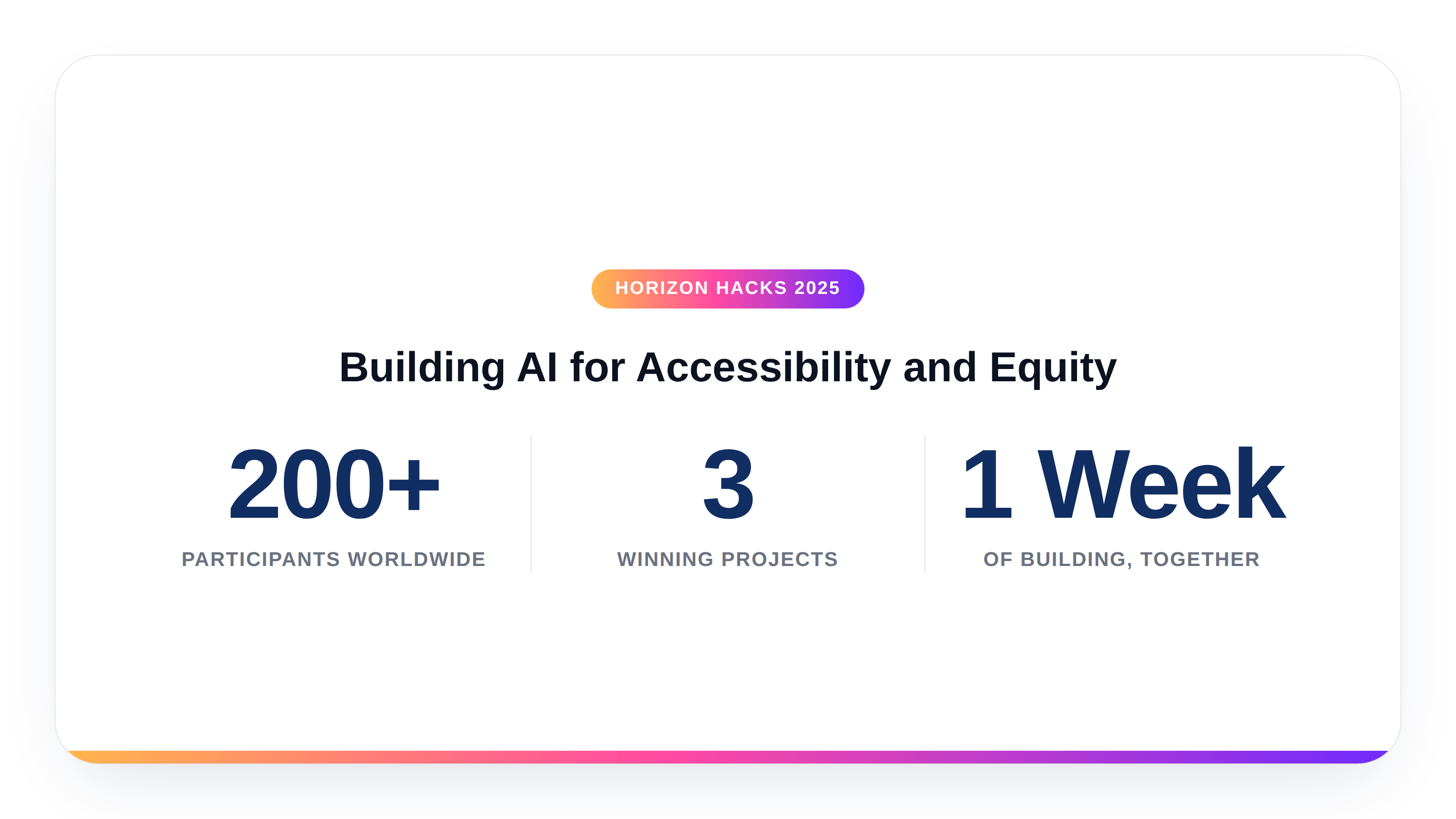 Horizon Hacks 2025 by the numbers
Outreach & Collaboration 🤝
Participants worldwide formed teams, shared ideas, and iterated quickly, often working with people they had never met before. Through open discussion and peer feedback, teams refined their ideas and pushed them toward practical, meaningful solutions. Horizon Hacks was glad to see the community involvement that went into this event.
Winning Projects 🏆
After careful evaluation based on innovation, feasibility, and impact, three standout projects emerged:
Adhyan
An AI-powered learning platform that transforms PDFs, text, and YouTube videos into structured study materials. By generating notes, flashcards, quizzes, and mind maps, Adhyan helps students learn more effectively and makes quality study tools more accessible.Synapse
An AI-driven cognitive training platform designed specifically for children with ADHD, autism spectrum disorder, and learning disabilities. Synapse focuses on personalized learning and skill development, offering targeted support for students often overlooked by traditional educational tools.Infera
A research-driven project exploring how intelligent systems can learn physical laws on their own. Infera allows particles to infer gravity, motion, and reality through Bayesian reasoning, pushing the boundaries of how AI can model and understand the world around it.
Each of these projects demonstrated not only technical excellence, but a strong alignment with the mission of accessibility and equity.
Looking Ahead 🚀
Horizon Hacks 2025 showed what is possible when young builders are given the freedom to explore meaningful problems and the tools to solve them. Every participant contributed to a larger conversation about responsible AI and inclusive innovation.
We are incredibly grateful to everyone who participated, mentored, judged, and supported this event. Horizon Hacks is more than a hackathon. It is a growing community committed to using technology to create fairer outcomes and real impact.
You can explore all projects and learn more about the event on the official Devpost page:
🔗 https://horizon-hacks-ai.devpost.com/
We are excited to see where these ideas go next and even more excited for what the Horizon Hacks community will build in the future.